🎷
How I design is how I lead
Leadership
When I had first managed designers, in 2015, I couldn't articulate if there was a process I was following. I felt my way through. Over the years, I've discovered that a core foundation of my design process is also applicable to leadership. This connection between my Design practice and my leadership practice has been a powerful hand in helping me navigate the uncertain landscape of design management.
Three foundational questions of Design
In 2019, when I was revisiting Alan Cooper's book, About Face: Essentials of Interaction Design, after 10 years - I re-read the following facets of user needs: Functional, Visceral and Reflective. These needs could be found out by asking foundational questions:
What is the user trying to DO?
How does the user want to FEEL?
Who does the user want to BE?
In the fast moving world of tech, we gravitate to focusing on the functional needs. We relegate Design as problem solving and forget that it is not just about that but also about creating an experience. And this possibility to create an experience really lies in addressing the other two needs.
While I had read about these in the past, only at this particular time did it truly click within me. This probably has to do with the experiences I've had over the years, the design problems I've solved at various organisations and most importantly my quest to understand human behaviour.
In my spiritual quest, I've come to realise that each one of us is in a constant state of becoming. While moving from becoming to being is the goal of spirituality, the material is all about becoming.
In the material world, if we really want to address one's core needs, we ought to address the functional, emotional and most importantly the reflective needs. Who are you trying to BE? How can a product / service help you in becoming who you want to BE?
So re-looking at these questions hit me like an epiphany that just made everything clear and formed a deep core about human behaviour. And, these questions form the foundation of my design process ever since.
As I moved to a leadership role a second time, it occured to me see if these principles can help me navigate the rather unclear waters of management. I'm not trying to force-fit a 'model' to a scenario. When you resonate so strongly with foundational questions - you want to see if they apply to other scenarios.
Connection to Leadership
Similar to how the three questions clarify the steps you need to take as a designer w.r.t a problem - they also apply to guide you towards the charter as a design leader.
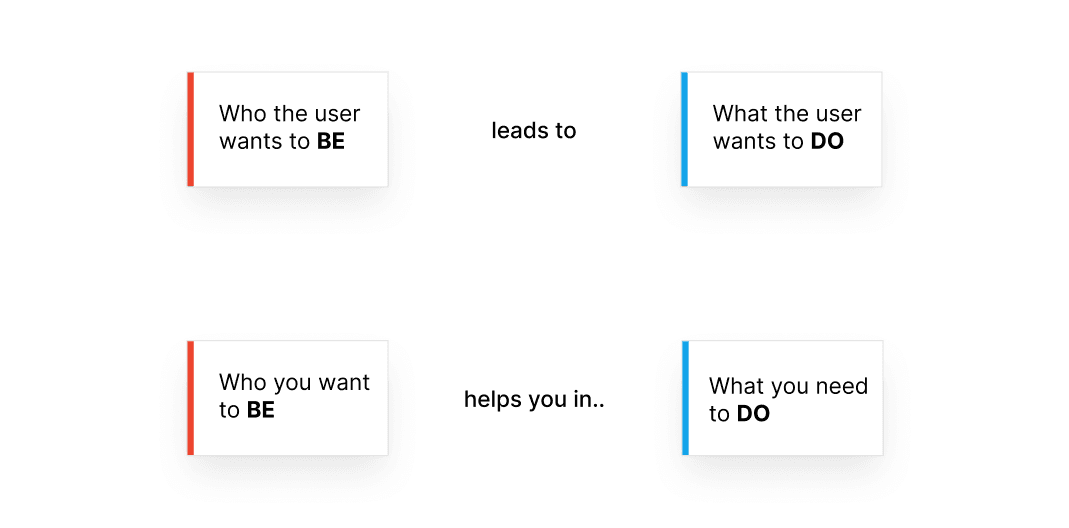
So, how do the above foundational questions apply? Substitute the 'user' with your team.
What should the team DO?
How do I want my team to FEEL?
Who should the team BE?
The Team Level
Your team is the heart of your design organization. Apply the framework here to create a thriving design culture:
DO
Foundational: Provide the right tools, subscriptions, and resources. Build a robust design library.
Operational: Establish effective workflows, implement design processes, and create valuable rituals.
Strategic: Define a clear vision and drive initiatives that push the team forward.
FEEL
How does my team feel today and how do I want my team to FEEL?
Team Health: Foster psychological safety, prevent burnout, and empower autonomy.
Engagement: Organize team-building activities and offsites to boost morale and connection.
BE
Brand: Cultivate a strong, cohesive design brand and identity.
Growth: Invest in training, workshops and talks to elevate the team's capabilities.
Who the user wants to BE? ➡ Vision
Vision is what drives me as a leader. The possible futures we could create for our users so that they get to become a certain version of themselves through the product offering is what motivates me. "Who the user wants to BE?" is the question to ask as a leader to envision a future.
A core competency of being a leader is to be able to deliver vision - have a point of view about the future. This doesn't have to do with management. However, once you are formally in the realm of management, you ought to make this a priority.
Outro
As I navigate my design leadership journey, I constantly ask myself:
What do I need to DO to drive success?
How do I want my team to FEEL?
Who do we want to BE as a design organization?
I do think that there are strong intersection points between a design process and managing a team. By bringing the same curiosity, empathy, and problem-solving mindset to leadership that you bring to design, we not only create better products but also build stronger, more resilient teams and organizations.


