🎍
Design competencies to nurture a team
Leadership
How do you know if you are doing well as a designer? How do you know if you are growing? As a leader, how do you build a high performing design team? Design competencies is the answer.
I have seen the power of competencies / rubrics in a previous organisation and I personally resonate with them, heavily. When I joined Appsmith as a Head of Design, it was important for me to provide clarity to the team in terms of how they are doing and where they need to invest in order to become great. Without competencies, it becomes really tough to have these conversations in a structured fashion.
Competencies can be thought of vectors that a person is performing in. Each of these vectors has a value. A group of these values thresholded at a certain 'level' leads to Designer levels. (Eg: Senior designer, Principal designer etc.)
As a leader, you have to see if your reports are getting the right opportunities to flex their muscles in the areas that they are interested in and in the areas that they need to improve on.
The following are the competencies I've created with the help of vast amount of literature that exists on the web, my experience as a designer and the needs of the company.
User-centricity
Problem-space research: Identifies the gaps in knowledge about the problem and seeks to address them through primary & secondary research.
Solution-space research: Validating solution designs through usability testing.
User-advocacy: Focuses on user outcomes and advocates for user experience based on the insights gathered and building solutions in the right manner.
Product Sense
Problem exploration: Ability to unearth various aspects of the problem and frame the problem properly.
Product domain understanding: Understanding of the competitive space of the product and the market forces that exist.
Big picture / Systems thinking: Focus on the big picture about the problem.
Design Craft
Solution ideation & exploration: Exploring the solution space in breadth and depth.
Design for the user journey and the system: Ability to see the interrelationships of the product across various touchpoints and solving for the system rather than the problem at hand.
Interaction Design: Ability to render the solution into the right experience using information architecture, interaction design laws & patterns.
Execution finesse: Visual design ability to create simple and elegant solutions that are harmonious as a whole.
Communication & Collaboration
Articulating Design decisions: Using storytelling, visuals and prototypes to effectively communicate design rationale and solutions.
Proactive communication about progress: Via verbal or documented artefacts.
Collaboration with stakeholders: Actively collaborates with people in sharing insights and collating feedback to drive effective design in the pod.
Drive for Results
Execution speed: Speed of executing design work with quality.
Bias for action: Mindset to act, getting things done in the product, ship to users and learn from the insights.
Design impact: Awareness & measurement of the impact of design work. Doing needed refinements to raise the impact.
Levelling up
Self-growth: Growth mindset to continuously learn and improve to be successful.
Mentoring & coaching: Mentoring other designers in order to be a force multiplier in the team.
Team growth: Advocates for changes & processes for better functioning of the team.
Ownership
Accountability of one's work: How accountable is the designer towards their work?
Care for the Product: Identifying quality issues inherent in the product & getting them fixed. Also linked to Bias for action.
Care for the User: Active involvement in user issues and identifying opportunities to fix them.
Care for the Org.: Initiatives to improve processes in the team and the Org.
The interesting thing I've realised with designing competencies is that they are weighted. It is really important to adjust the weights based on the needs of the company.
Competencies in the hiring process
I use these competencies also as part of our hiring process.
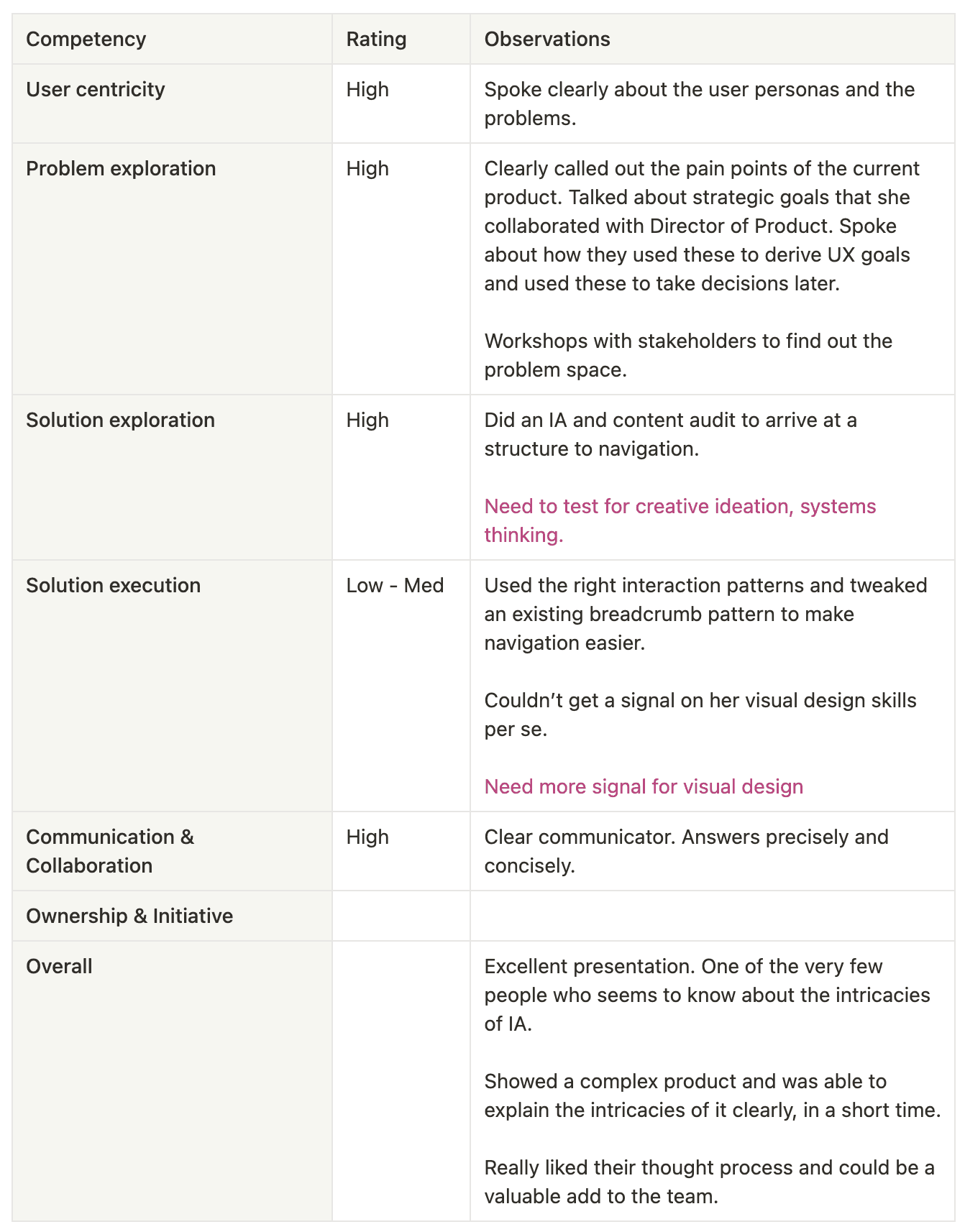
Every interviewer documents their conversation with a candidate against our competencies. Each interviewer can see these notes and understand at a glance how the person has fared, provide structured feedback and also get notes on what they have to test.
All my feedback for my reports is also structured around the competencies. For me and the managers to go even granular, we have sub-competencies defined against each of them so that it helps them articulate their observation, better.
Competencies make life so much easier both as a team member to provide clarity on the various dimensions they'd need to flex and for the managers in helping to guide their team on the path of growth. This is a topic of a lot of interest to me. I would love to hear how you use them in your Org. Hit me up, if this topic interests you.


